
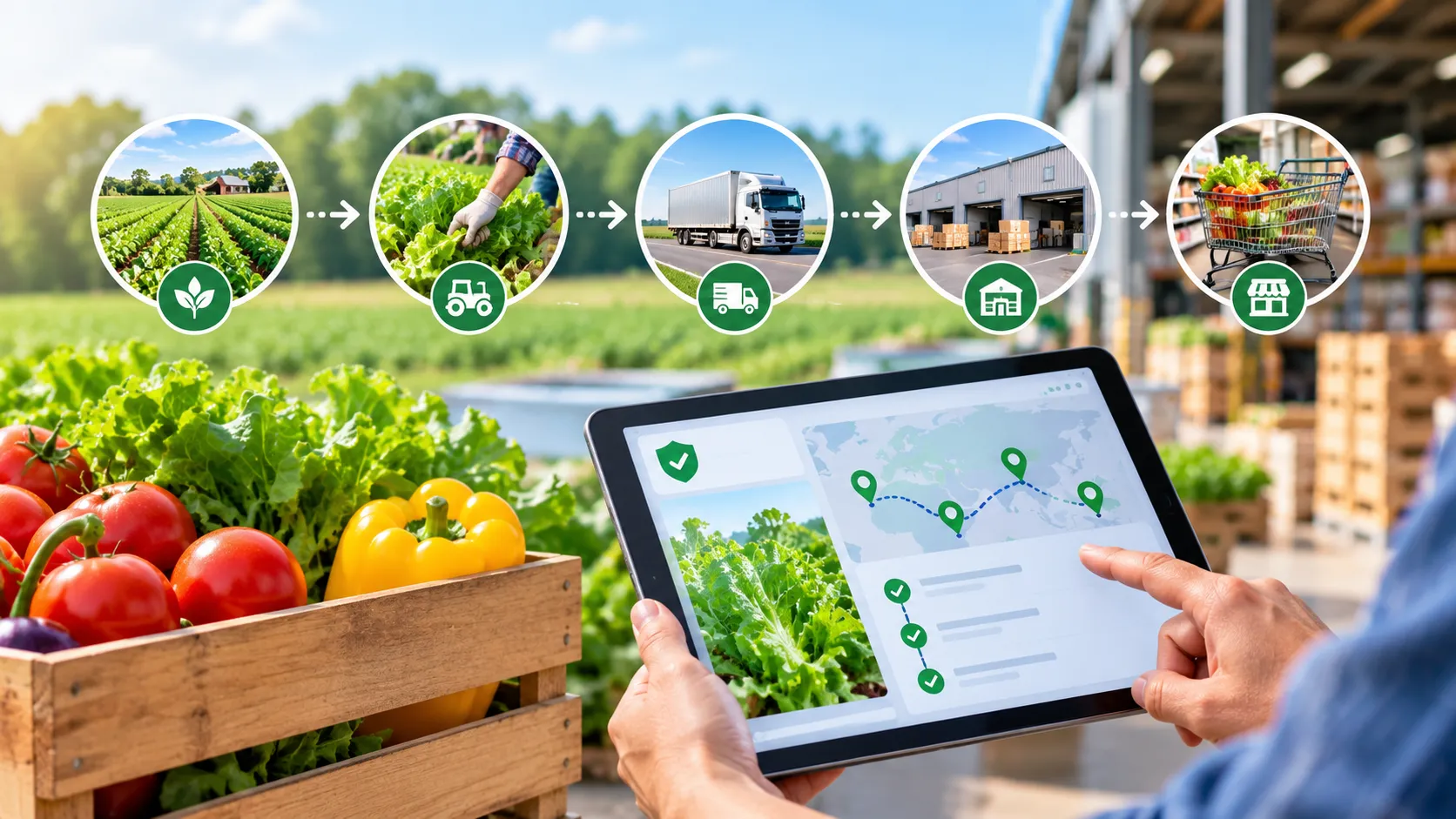

Fresh produce is sold on trust. A buyer wants to know where it was grown, whether it was handled responsibly, how long it has been in the chain, and what happens if a food-safety concern emerges. For food businesses, answering those questions is becoming a commercial expectation as well as an operational responsibility.
Transparency does not mean publishing every detail of a supply chain. It means being able to see, verify, and communicate the information that matters: product origin, growing and harvest information, handling conditions, supplier accountability, and the route from field to customer.
That is where food traceability becomes practical. It gives food businesses a structured way to connect information across growers, packers, processors, distributors, and retail or foodservice customers. The result is not simply a better story for consumers. It is a stronger operating record for quality teams, procurement leaders, and supply-chain partners.
Here are nine ways food businesses can make fresh-produce supply chains more transparent while improving the information they can act on every day.
1. Identify produce at its point of origin
Transparency starts before a product reaches a warehouse or processing line. A business should be able to identify the farm, grower group, field or growing area, commodity, and harvest period associated with a particular lot.
The level of detail will vary by product and business model, but the principle stays the same: do not rely on a broad supplier name when a more precise origin record is possible. “Imported tomatoes” or “supplier shipment 1847” may be enough for a purchasing summary, but it is not enough to investigate a quality issue quickly or explain provenance with confidence.
Origin records also help businesses understand differences in crop performance. If one sourcing region regularly produces more waste, shorter shelf life, or repeated quality defects, the company can investigate the cause instead of treating every delivery as identical.
2. Preserve harvest and packing details with each lot
A harvest date is useful, but fresh-produce supply chains often need more context. A transparent record should connect the lot to relevant events such as harvest timing, initial cooling, packing location, packing date, and any lot or batch code assigned along the way.
This is particularly important where product from multiple fields, growers, or harvest windows is packed on the same day. Without a clear link between the incoming produce and the packed output, businesses can lose visibility exactly when they need it most.
For food businesses, the goal is not to create paperwork for its own sake. It is to retain the information needed to answer a practical question: which product entered this facility, what happened to it here, and which finished lots or customers were affected?
3. Make handling conditions visible, not assumed
Fresh produce does not remain static after harvest. Cooling, storage, loading, receiving, and transport all influence quality and shelf life. A transparent supply chain captures the conditions that materially affect the product rather than assuming that a handoff happened correctly.
For some operations, that may mean recording when produce was cooled and received. For others, it may include temperature readings, storage location, transport checks, delays, rejected loads, or corrective actions. The right level of detail depends on the commodity, the risk profile, and the agreements between trading partners.
A record of handling conditions is valuable because it turns quality conversations into evidence-based conversations. If a customer reports a shelf-life problem, the team can check the relevant handoffs and conditions rather than relying only on memory or broad delivery records.
4. Use temperature data as an operating signal
Temperature records are often treated as a compliance file: important if someone asks for them, but otherwise separate from commercial decisions. That leaves useful information on the table.
When temperature data is tied to a lot, shipment, receiving event, or storage location, it can help teams spot patterns. Are problems concentrated on a certain route? Does a particular loading window lead to more rejected product? Are some products consistently exposed to warmer conditions before they reach the customer?
The point is not that every business needs an expensive sensor network. It is that the temperature information already being collected should be linked to the product and decision it relates to. Simple, consistent records can help a team prioritize process improvements, reduce disputes, and protect product quality.
5. Connect incoming produce to processing and transformation events
Transparency becomes harder when incoming produce is sorted, washed, cut, blended, repacked, or combined into a new product. These are the moments when one lot can become several outputs, or several incoming lots can become one finished item.
Food businesses need a clear record of those transformations. That includes what lots entered the activity, what process occurred, when it happened, and which output lots resulted. This matters for fresh-cut produce, prepared foods, juice, sauces, frozen products, and any operation where product identity changes after receipt.
It also matters commercially. A processor that can see the relationship between raw material and finished output is better equipped to investigate yield loss, quality complaints, supplier performance, and customer questions. Transparency is not only about the past; it supports better purchasing and production decisions going forward.
6. Keep supplier records complete and current
Supplier information should not live across disconnected spreadsheets, inboxes, and shared folders. A transparent supply chain depends on knowing who supplied a product, which sites they operate, what specifications apply, and whether required documentation is current.
A useful supplier record may include contacts, approved commodities, growing or packing locations, food-safety documents, audit status, quality requirements, insurance or certification details, and the traceability information expected with every shipment. The exact list depends on the business, but ownership of the information should be clear.
When supplier records are maintained alongside product and lot data, teams can respond faster. A quality manager does not have to search for a certificate after a complaint arrives. A buyer can see whether a new source has the required documentation before making a commitment. A food business can also identify gaps before they become a customer or regulatory issue.
7. Create a recall-ready record before a recall is needed
No food business wants to manage a withdrawal or recall. But preparedness is not pessimism; it is responsible operating design.
A recall-ready record allows a team to quickly identify the affected product, suppliers, internal handling events, finished lots, and customers. The goal is to narrow the scope using reliable facts rather than reacting with a broad and disruptive assumption.
Run a periodic traceback exercise using a real or simulated lot. Ask whether the team can locate the source information, follow the product through handling and processing, identify the customers who received it, and produce the relevant documentation without assembling it manually from multiple systems. Any delay or missing handoff is a useful finding.
For US businesses handling foods covered by the Food Traceability Rule, these processes have added importance. The US Food and Drug Administration’s rule is built around key data elements and critical tracking events that help the agency and supply-chain partners trace certain foods more effectively. The core operational lesson applies more broadly: record the event when it happens, not after a problem forces the team to reconstruct it.
8. Give customers information they can understand and use
Supply-chain transparency should improve the customer experience, not overwhelm it. Business buyers, retailers, foodservice operators, and consumers may need different information, but each should receive clear and appropriate proof.
A retailer may need lot-specific data, supplier documentation, and the ability to respond to a food-safety inquiry. A foodservice buyer may need confidence in product handling and delivery records. A consumer may want a concise explanation of origin, sourcing practices, or seasonality.
The most effective approach is to maintain one dependable underlying record and present the relevant portion to each audience. A QR code, product page, delivery document, or customer portal can be useful, but it only adds value if the information behind it is current and credible.
9. Review data for improvement, not just compliance
Transparency systems are often judged by whether they can produce a report. A stronger test is whether the information changes better decisions.
Review supply-chain records for recurring quality claims, delays, temperature excursions, waste levels, supplier nonconformances, and incomplete documentation. Look for the reasons behind the pattern. Is a particular crop, grower region, carrier route, packing process, or receiving step producing avoidable risk?
Regular review turns traceability data into operational intelligence. Procurement can make more informed sourcing decisions. Operations can improve handling. Quality teams can focus audits and corrective actions. Sustainability teams can begin to validate claims with production and supplier evidence rather than estimates alone.
How Food Traceability Turns Transparency Into Verifiable Proof
Transparency is a promise; traceability is the evidence that supports it.
A food business may tell customers that it knows where produce was grown, handles it responsibly, and works with accountable suppliers. Food traceability makes those statements testable by connecting product identity to the records created at each step: origin, harvest, cooling, packing, shipment, receiving, processing, and delivery.
The difference matters when questions become specific. Where did this lot come from? Which harvest and packing event was involved? Was the product held at the right temperature? Which supplier documents were active at the time? Did the product enter a transformation process, and where did the resulting output go?
When that information is stored in connected records, a business can provide a reliable answer without relying on a chain of emails or individual memory. It can also distinguish between a general marketing claim and a verifiable operational fact.
For fresh-produce businesses, this is a practical advantage. Better records support faster investigations, more confident customer communication, tighter supplier accountability, and more targeted corrective action. They also create a stronger foundation for sustainability and provenance claims, because the underlying chain of custody is visible rather than assumed.
Fresh-produce transparency is not achieved through one label, one sensor, or one software purchase. It comes from consistent data practices across the people and handoffs that move food from field to customer. Businesses that build those practices now will be better placed to protect quality, reduce waste, respond to risk, and earn trust over time.